
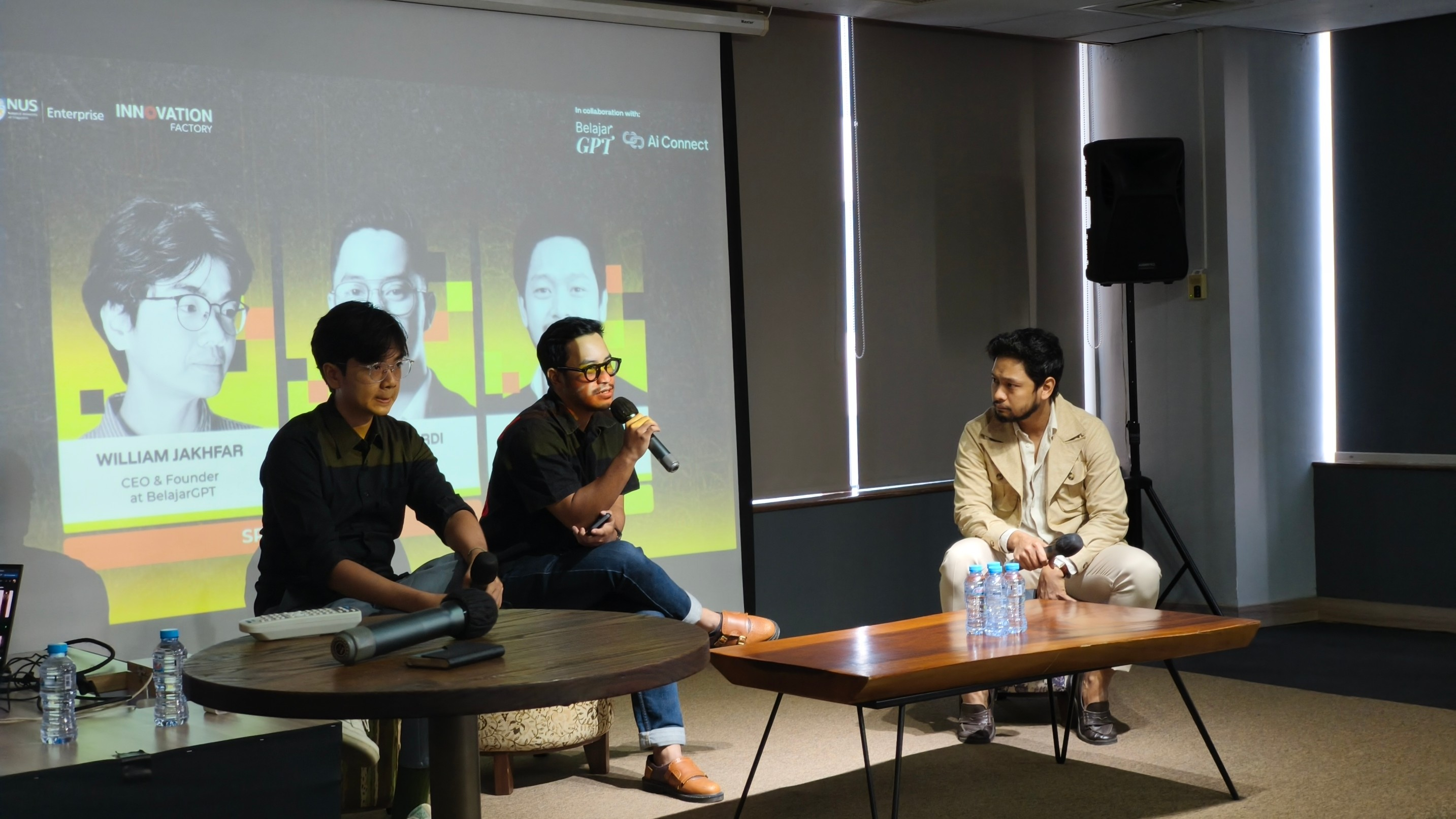
A special serving by BLOCK71 Indonesia and Innovation Factory, in collaboration with BelajarGPT and AI Connect.
On Thursday, 16 July 2026, BLOCK71 Indonesia and Innovation Factory hosted the July 2026 edition of KopiChat, bringing founders and builders together for an insightful discussion about how startups are really using AI agents today. Joined by speakers from BelajarGPT and AI Connect, the session addressed a question every founder is asking right now: when AI can build almost anything, what actually gives one startup a competitive advantage over another?
The panel featured William Jakhfar, CEO & Founder of BelajarGPT, and Mizan Lazuardi, Programme Lead at AI Connect, with BLOCK71's Programme Manager, Andit Intasworo, as moderator. Here are the key takeaways from their discussion.
AI makes building easier, but that's no longer the advantage
The discussion opened with a simple observation: AI agents aren't just better chatbots, they're changing how work actually gets done. Building a product is no longer a startup's biggest challenge; with AI, almost anyone can put together a working prototype in a short amount of time.
But that's exactly why building alone isn't a competitive advantage anymore. If the barrier to creating something is low for everyone, then what a founder does after the prototype, how they validate it, refine it, and bring it to real users, is what actually separates one startup from another. Execution, in other words, still matters just as much as it always has.
Trust is the real competitive advantage
If everyone can build the same thing, the discussion made one thing clear: the real differentiator isn't the technology itself, its trust. As William put it, "if everyone can build the same product, why would customers choose yours?"
Technology is easy to replicate; trust is much harder to replicate. That trust is built through brand, emotional connection with users, and a genuine understanding of the problem being solved, not just the feature set. William pointed to distribution as part of this picture too: with AI lowering the barrier to building, marketing, audience, and customer acquisition carry more weight than before, because reaching the customer and earning their trust matters just as much as the product itself.
AI + Humans: redesigning workflows, not replacing people
The conversation also challenged one of the biggest misconceptions about AI: the future isn't AI versus humans, it's AI plus humans. Mizan framed it clearly that "AI accelerates the process of thinking, but execution remains a human capability." AI should augment humans, not replace them.
Rather than asking "can AI do it," the panel encouraged founders to ask "should AI do it." Not every part of a business needs, or should have, AI involved. William illustrated this through the difference between customer service and sales: the answer depends on where you are in the funnel. AI agents are efficient at handling high volume, repetitive tasks like answering common questions at scale, but they still struggle with context and meaningful follow up. Humans remain essential where relationship building and reading customer nuance matter, particularly further down the funnel where trust and follow through close the deal. The goal isn't choosing AI or humans, it's designing workflows with a human in the loop, deciding deliberately where each one belongs.
The real challenge isn't building AI, it's integrating it
Mizan challenged the idea that building AI models is still the hard part. In his view, the harder problem today is integration: connecting systems, getting different tools to communicate, orchestrating multiple agents effectively, designing proper governance, and building architectures that can actually scale.
He also emphasized starting with the problem, not the technology: understanding why the product needs to exist and who the user is before adding AI into the mix. AI should solve a real user problem, not exist for its own sake.
This same idea of accessibility versus real challenge came up around vibe coding too. AI is genuinely democratizing software creation, more people than ever can build something that works. But William was direct about the risk: relying too heavily on AI generated code without understanding it can introduce security vulnerabilities, and good software architecture still requires real engineering thought. Building is becoming easier, but building something people actually use, and can trust, is still the real challenge.
Key Lessons
AI is lowering the barrier to building products, but raising the bar for creating real value. The startups that win won't be the ones with access to the best AI, everyone will have that. They'll be the ones that solve real problems, earn lasting trust, and know where humans create the most value alongside AI.
KopiChat is BLOCK71 Indonesia's ongoing series of honest, community driven conversations for founders and builders. Want in on the next session? Follow Innovation Factory & BLOCK71 Indonesia for more event updates & insights.