
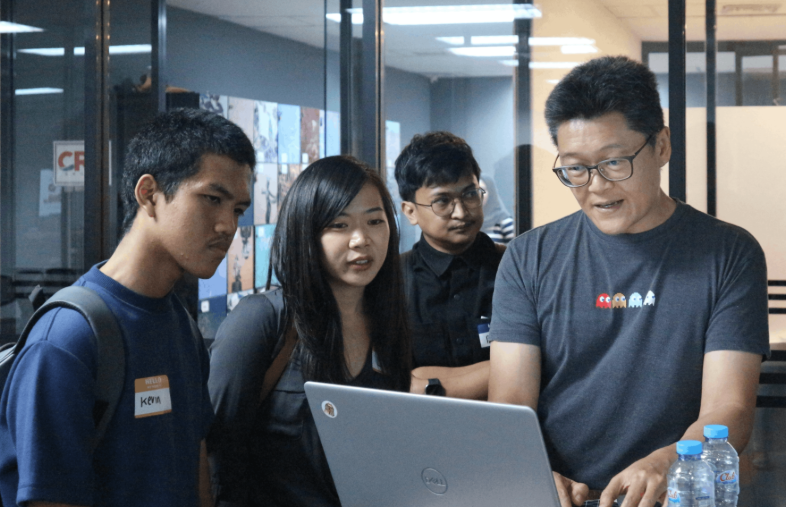
Session by BLOCK71 Indonesia and Innovation Factory, featuring Alex Tan, supported by Prodia
As AI becomes part of everyday marketing, today’s marketers can build a landing page, a case study, or a campaign brief in minutes. But what sets effective AI users apart—and how can they turn AI into a real advantage? On Thursday, August 20, 2026, Innovation Factory and BLOCK71 Indonesia, supported by Prodia, hosted Agentic AI for Modern Marketers, a Live Demo with Alex Tan exploring how AI Chat, AI Workflows, and AI Agents serve different roles in marketing.
Understanding How AI Works in Marketing
Alex breaks AI into three practical categories: AI Chat provides instructions or ideas for users to execute themselves, while AI Workflows follow predefined processes based on specific conditions, making them useful for repetitive and predictable tasks. AI Agents take things a step further by making decisions based on an objective and the situation they encounter.
Drawing from his experience as Co-Founder of Sejasa.com, a home services platform serving households across Southeast Asia, Alex demonstrated how these approaches can work together in practice. During the live demo, he used n8n to automate a process that collected site photos and handwritten job sheets, processed the information, and sent it to GPT to generate a case study draft. Slack then notified Alex for review and final approval before publishing.
The next step is where an AI Agent comes in. Using Flowise, Alex showed how an agent can take the draft and make decisions that a predefined workflow would not, such as selecting the three most suitable images and arranging the layout. Alex then reviews the completed draft and gives the final approval.
To explain the difference, Alex uses a simple kitchen-fire analogy. If your kitchen catches fire, AI Chat tells you what to do. An AI Workflow follows a planned response, while an AI Agent can recognize situations that were not explicitly planned for and act based on judgment rather than a fixed script.
“You still need to be on the steering wheel — agents make their own decisions based on objectives, and that's exactly why oversight matters more, not less.”
— Alex Tan
Choosing the Right AI Approach
While the kitchen-fire analogy highlights an important distinction in how these approaches operate, it also raises a practical question: when should you use a workflow, and when is an agent the better fit? For Alex, the answer isn’t about choosing the smartest model. It comes down to the cost of error and whether the quality of the output can be evaluated.
When the cost of error is low and the quality can be checked objectively, a workflow can be a good fit for the task. But when the cost of error is higher or the quality depends more on human judgment and taste, an agent requires closer human oversight. The key is not simply choosing the most advanced AI, but matching the approach to the task and the level of judgment it requires.
Give Agents a Strong Brand Foundation
Once users ensure that an agent is the right fit for a task, the next step is giving it enough structure to work within. For Alex, that starts with a clear brand foundation. Rather than relying on a fixed workflow, an agent can work from an established brand structure and campaign direction, allowing it to make decisions while staying aligned with what the brand is trying to achieve.
Alex illustrated this approach through an example campaign for a new F&B product launch. He gave the agent the brand they had established and an initial campaign idea, then the agent asked questions about the campaign objective, target audience, and product direction to build a shared understanding. From there, it developed a marketing strategy brief, messaging and tagline ideas, image prompts, visual concepts, a video, and a landing page based on the agreed direction. The established brand structure helped keep the outputs aligned, while Alex remained involved in making the final creative decisions.
Build an AI Ecosystem, Not Just a Collection of Tools
With the brand foundation in place, the next challenge is connecting the different capabilities that allow an agent to work across these tasks. Alex explained that this setup brings together skills, connectors, and plugins. In his workflow, he packages these capabilities into a plugin for Claude Code, combining skills such as writing a brief, generating image prompts, and building a landing page with connectors that give the AI access to tools for image and video generation, Google Maps, and Search Console.
He also highlighted resources that have earned a permanent place in his workflow, including Matt Pocock’s work on AI-assisted coding and Impeccable, a UI/UX plugin that can read a brand and create variations of websites and interfaces, helping move away from the generic look often associated with AI-generated websites.
But adding more capabilities is only useful if the output can still be trusted. For Alex, that means keeping the quality check separate from the generation process. Rather than having the same AI generate and evaluate its own work, he uses a separate QA Agent as a third party to check the output more strictly for quality and brand compliance.
This adds another layer to the ecosystem: AI can take on more of the work, but each capability still needs to operate within clear guidelines and checks.
Turn Marketing Data into One Clear Action
The same approach can also be applied beyond content and campaign execution. As another example of how he uses AI in his workflow, Alex showed a tool he built to analyze his marketing data. Because he manages multiple brands, he doesn’t have time to go through Google Ads, Google Search Console, and Google Merchant Center individually. Instead, he feeds the data into one central area, bringing together reports, ads, SEO, impressions, and other marketing data. Each week, the AI reviews the data and gives him one thing to focus on, such as cutting the budget for specific campaigns. If he wants to understand the recommendation, it can also explain the reasoning behind it.
And the system doesn’t stop at making the recommendation. If Alex keeps ignoring it for three or four weeks, the messages become increasingly persistent—and even a little passive-aggressive. What starts as a simple “Do this” eventually turns into reminders like, “Stop waiting, either way, next cycle we act.” It’s a lighthearted example of how Alex uses AI to turn a large amount of marketing data into one clear priority, so he can focus on what needs to be done without having to dig through every report himself.
The Bottom Line
Across these examples, one idea keeps coming back: the value of AI is not only in what it can produce, but in how it is set up to work. Alex’s approach combines different AI capabilities with clear brand guidelines, structured processes, quality checks, and human oversight.
That is why choosing the “right” AI model is only part of the equation. The more important question is how workflows, agents, and supporting tools can be designed around the needs of the task. When AI is given the right structure and the right level of human involvement, it can move beyond simply generating outputs and become a practical part of how marketing work gets done.
Curious about what AI can do and where it’s taking us next? Follow Innovation Factory & BLOCK71 Indonesia for more practical insights, expert sessions, and conversations shaping the future of work.